
Our Story: Creativity Builds Communities
1975–2008: Bringing the arts closer to home
 Catamount Arts began in 1975, when filmmaker Jay Craven started bringing film and performing arts to rural audiences. Early screenings traveled by truck to communities across northern Vermont and New Hampshire. Our first film was Charlie Chaplin’s Limelight—the beginning of a story shaped by artists, audiences, volunteers, and neighbors coming together.
Over the following decades, Catamount expanded its programming and established a home in St. Johnsbury. In 2005, the local Masonic Lodge gave Catamount its historic building on Eastern Avenue, retaining use of the top floor.
Community members helped shape its transformation. Students from St. Johnsbury Academy’s Building Trades and Electricity programs, participants from the St. Johnsbury Work Camp, and many other contributors helped create the Arts Center that officially opened on October 4, 2008. Cinemas, galleries, classrooms, and performance space gave the community new opportunities to experience and create art.
2009–2010: Looking outward
With the Arts Center established, Catamount undertook a major strategic reassessment. We looked beyond our building to ask how we could better serve the artists, organizations, and communities around us.
The region was already rich in talent. Artists were creating remarkable work. Arts organizations were bringing people together. Dedicated volunteers were investing their time and imagination in the places they loved.
What many needed was greater capacity: administrative support, technical expertise, equipment, and dependable systems to help their ideas succeed.
Catamount began directing more of its resources toward meeting those needs. Our commitment to the arts meant helping others gain the tools to create, present, and sustain their own work. That understanding became a guiding principle for our growth.
2010–2016: Building resources the region could share
In 2010, Catamount launched the Regional Box Office through a partnership with Circus Smirkus to provide ticketing for its Big Top Tour. What began with one partnership grew to serve more than 40 organizations, helping partners connect with audiences and manage the administrative work behind their performances.
In 2016, we acquired our first mobile stage and began deploying it across the region with sound and lighting equipment, professional staff, and college interns.
Communities gained access to the equipment and expertise needed to turn local gathering places into performance venues. Volunteers and presenting partners brought their local knowledge and relationships; Catamount contributed professional production support. College interns learned alongside experienced staff, developing skills through work that directly served the region.
2017: EPIC Music takes root
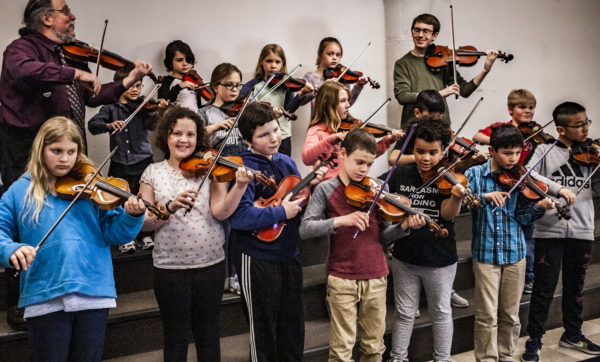 Our commitment to artistic excellence and access also shaped the launch of EPIC Music in 2017.
Inspired by El Sistema, the music education movement that began in Venezuela, EPIC is an intensive string program that brings young people together through sustained instruction, ensemble rehearsal, and performance.
Students learn violin, viola, cello, and bass with professional teaching artists and the support of community musicians. They practice listening, persistence, and collaboration while discovering the responsibility and joy of playing in an ensemble. Performances with the Northeast Kingdom Community Orchestra connect young musicians with a wider musical community.
Instruments are provided at no charge, participation is subsidized, and financial assistance helps reduce barriers. Musical learning takes place in an environment where students can challenge themselves, support one another, and develop a sense of belonging.
EPIC expresses a conviction that runs through Catamount’s work: young people in rural communities deserve meaningful opportunities to encounter great artistry and develop their own.
2017–2020: Research informs the path forward
A USDA grant received in 2017 supported research into the Northeast Kingdom’s creative economy. Working with the Vermont Arts Council, the Vermont Creative Network, researchers, and regional partners, Catamount helped examine the region’s creative strengths and the resources needed to sustain them.
The resulting report, Building on a Legacy of Creativity: Understanding and Expanding the Creative Economy of the Northeast Kingdom, was completed in December 2018. It documented a substantial creative economy and identified opportunities to strengthen business support, shared spaces, professional networks, and pathways into creative careers.
Those findings informed Catamount’s subsequent strategic planning. Adopted in October 2020, the plan made regional capacity a central priority, connecting community hubs, production services, artist business support, opportunities for young people, and the reuse of buildings for creative enterprises.
2020–2024: Sustaining connection through change
During the pandemic, Catamount adapted music instruction, developed community art projects, presented outdoor and drive-in programming, and broadcast First Night North. The creation of ArtPort at St. Johnsbury’s Green Mountain Mall provided another space for gathering and live performance.
When air-quality concerns temporarily closed the Eastern Avenue Arts Center in 2023, Catamount continued working through other locations while environmental remediation addressed the building’s needs. We celebrated our return in June 2024.
These experiences reinforced the importance of regional partnerships, flexible resources, and the people who keep creative work moving through difficult circumstances.
2025–2026: A regional vision at scale
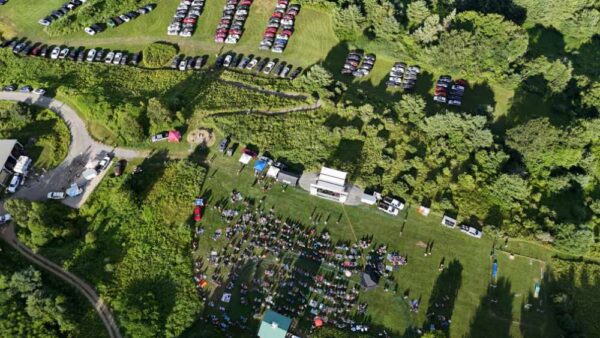
Catamount celebrated its 50th anniversary in 2025 with music, film, poetry, visual art, and community gatherings—including a return screening of Limelight.
By the summer of 2026, the regional production work that began with one mobile stage had grown to three, serving communities within a 50-mile radius of St. Johnsbury across Vermont and New Hampshire. Together with local partners, Catamount helped deliver more than 80 free summer concerts, with combined attendance exceeding 120,000.
That reach reflects years of investment in equipment, professional crews, paid internships, and relationships with communities. It allows local ambition to become a well-supported public event, bringing residents and visitors together in downtowns, parks, waterfronts, and other gathering places.
Our work also extends into municipal planning and decision-making. We help communities incorporate the creative economy into local government priorities, connecting arts and culture with public spaces, downtown vitality, and long-term community development.
Catamount estimates that its programs and regional partnerships contribute more than $5.5 million in annual regional economic impact. Alongside that activity are the everyday benefits of a lively community: reasons to visit downtown, opportunities for local businesses, places to encounter neighbors, and shared experiences that make people feel connected to where they live.
The Creative Campus gives this work a lasting home. Bringing the Arts Center together with three neighboring buildings, it combines space for Catamount’s programming with rental facilities for creative organizations and businesses. Rehabilitation and building improvements preserve community assets while supporting the people and enterprises that use them.
Catamount today: Artistry, opportunity, and belonging
The arts remain at the heart of everything we do.
Through KCP Presents, Catamount brings internationally acclaimed musicians, ensembles, dancers, and theater artists to rural audiences. Our film programming, exhibitions, community arts projects, and educational offerings invite people to encounter different perspectives and develop their own creative voices. EPIC Music, First Night North, and free concert partnerships offer distinct ways to learn, participate, and celebrate together.
Supporting this artistic life is a regional network of creative infrastructure: people, places, equipment, expertise, and relationships. Our box office, mobile stages, production teams, internships, facilities, and community partnerships help artists and organizations accomplish work they could find difficult to sustain independently.
This direction grows from what we recognized in 2009–2010: the region has extraordinary creative talent and commitment. Shared resources help that creativity reach further.
We carry that purpose into our next fifty years—with a commitment to exceptional artistic experiences, stronger opportunities for artists and young people, and communities equipped to sustain their own creative futures.